How to Select Vehicle Emissions Testing Equipment
Select emissions equipment from the applicable method, vehicle population, calibration arrangement and data interface rather than from the number of channels on the analyzer.
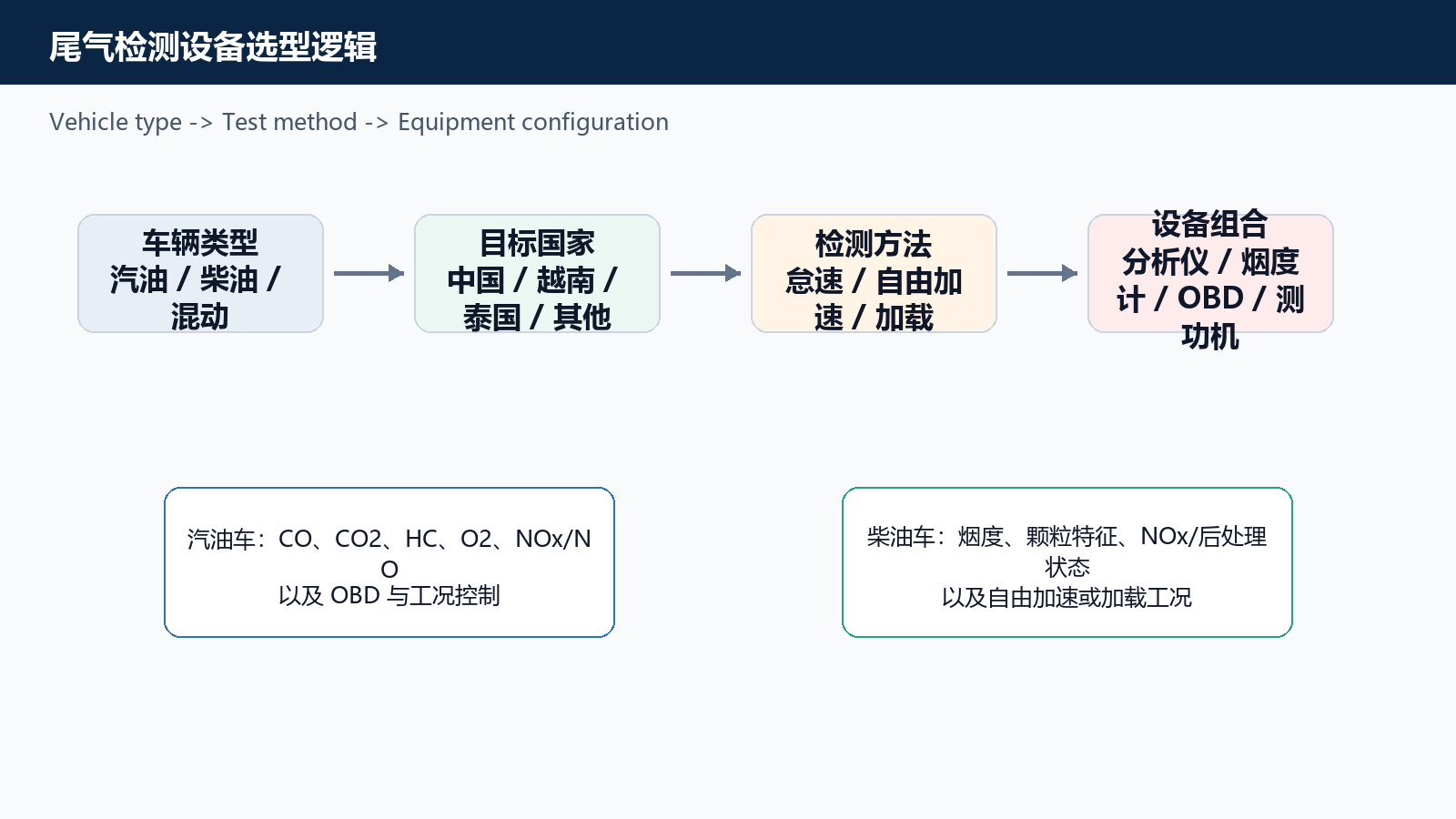
The first question is not whether a four-gas or five-gas analyzer looks more advanced. The correct starting point is the prescribed inspection method: gasoline and diesel vehicles measure different phenomena and may require different operating conditions.
A dependable proposal defines the complete measurement chain, including sampling, gas conditioning, RPM and temperature acquisition, environmental sensors, calibration media, lane software, data reporting, ventilation and operator safety.
Start with the applicable inspection method
Gasoline programs may use two-speed idle, idle, ASM or other loaded procedures depending on the jurisdiction. Diesel programs may use free-acceleration opacity, lugdown or other methods. Each method determines the analyzer or opacimeter, sampling response, vehicle signals and supporting lane equipment.
Confirm the legal document, vehicle categories, fuel types, model-year rules and pass/fail limits before comparing brochures. A channel that is not required by the method adds little value; a missing signal or interface can prevent the whole lane from operating.
Treat the analyzer as part of a measurement system
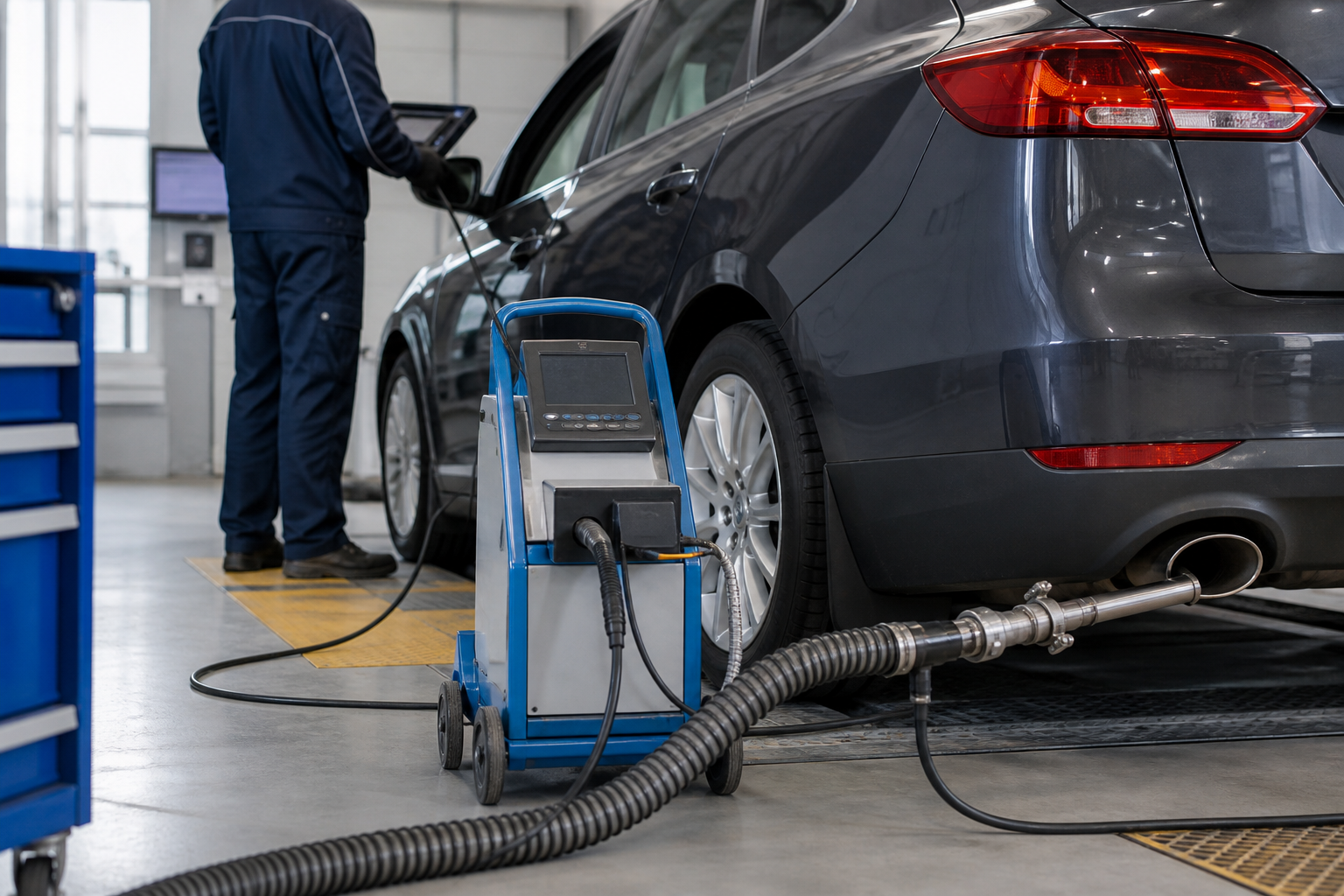
Sampling probes, hoses, filters, water separation, zero and span media, RPM pickup, oil-temperature measurement and environmental compensation all influence the result. Their compatibility and maintenance intervals should be documented.
Loaded testing adds a chassis dynamometer, speed and load control, cooling airflow, exhaust extraction, safety interlocks and synchronized software. These elements must be accepted as one system under real operating conditions.
Four-gas and five-gas analyzers
A conventional four-gas configuration commonly measures CO, CO2, HC and O2. A five-gas configuration adds NO or NOx capability, but the exact measurand, range, response time and intended method must be checked. The phrase 'five gas' alone does not establish regulatory suitability.
Ask for the measurement principle, ranges, resolution, warm-up behavior, interference control, zero/span procedures, sample-flow monitoring and evidence of conformity. Also confirm whether the software calculates lambda or dilution indicators required by the program.
Diesel smoke opacity
An opacimeter evaluates light attenuation by diesel exhaust. Optical path length, response, contamination control, purge arrangements and handling of exhaust pulses affect performance. The test procedure also requires stable RPM detection and correct acceleration recognition.
For free-acceleration testing, the software should guide preconditioning, acceleration validity, sequence acceptance and averaging. For a loaded method, the dynamometer and vehicle-safety conditions become part of the regulatory measurement.
Data, metrology and service
Verify serial-number control, software versioning, user permissions, raw-data retention, time synchronization, video linkage and the protocol used by the local authority. Metrological verification or calibration documents should cover the actual configuration delivered.
After-sales planning should identify commissioning, operator training, routine consumables, local spare parts, remote diagnosis, update policy and response responsibility. These items determine uptime long after the purchase price is forgotten.
A decision that can be audited
A final selection sheet should state the market, vehicle and fuel scope, inspection method, throughput, utilities, interfaces, metrology, installation, acceptance tests, training and maintenance. Anything not supported in writing remains an open technical or commercial item.
A compliant analyzer is necessary, but it is not sufficient. Regulatory suitability belongs to the complete method, lane, software and operating process.
Official references
This article is based on the official publications below. Verify the current edition, effective date and local authority requirements before application.
- GB 18285-2018: Limits and measurement methods for emissions from gasoline vehicles, including the two-speed idle and simplified driving-mode methods; effective 1 May 2019.
- GB 3847-2018: Limits and measurement methods for emissions from diesel vehicles, including free-acceleration and lugdown methods; effective 1 April 2019.
- QCVN 85:2025/BNNMT: Vietnam technical regulation for emissions from in-use motor vehicles, including five levels for CO, HC and diesel smoke opacity; effective 16 December 2025.
- US EPA I/M guidance: Vehicle emissions inspection and maintenance programs are implemented by state and local programs under the Clean Air Act; OBD is a major component.
- UNECE WP.29 / UN Regulations: The 1958, 1997 and 1998 Agreements cover type approval, global technical regulations and periodic technical inspection.
- MEE: GB 18285—2018
- MEE: GB 3847—2018
- SAMR: On-site assessment guidance for vehicle inspection bodies