Gasoline and Diesel Emissions Inspection: Measurement Principles, Sampling Chains and Test Conditions
Gasoline analyzers and diesel smoke meters measure different pollutants through different procedures, so their equipment chains, vehicle signals and quality controls cannot be treated as interchangeable.
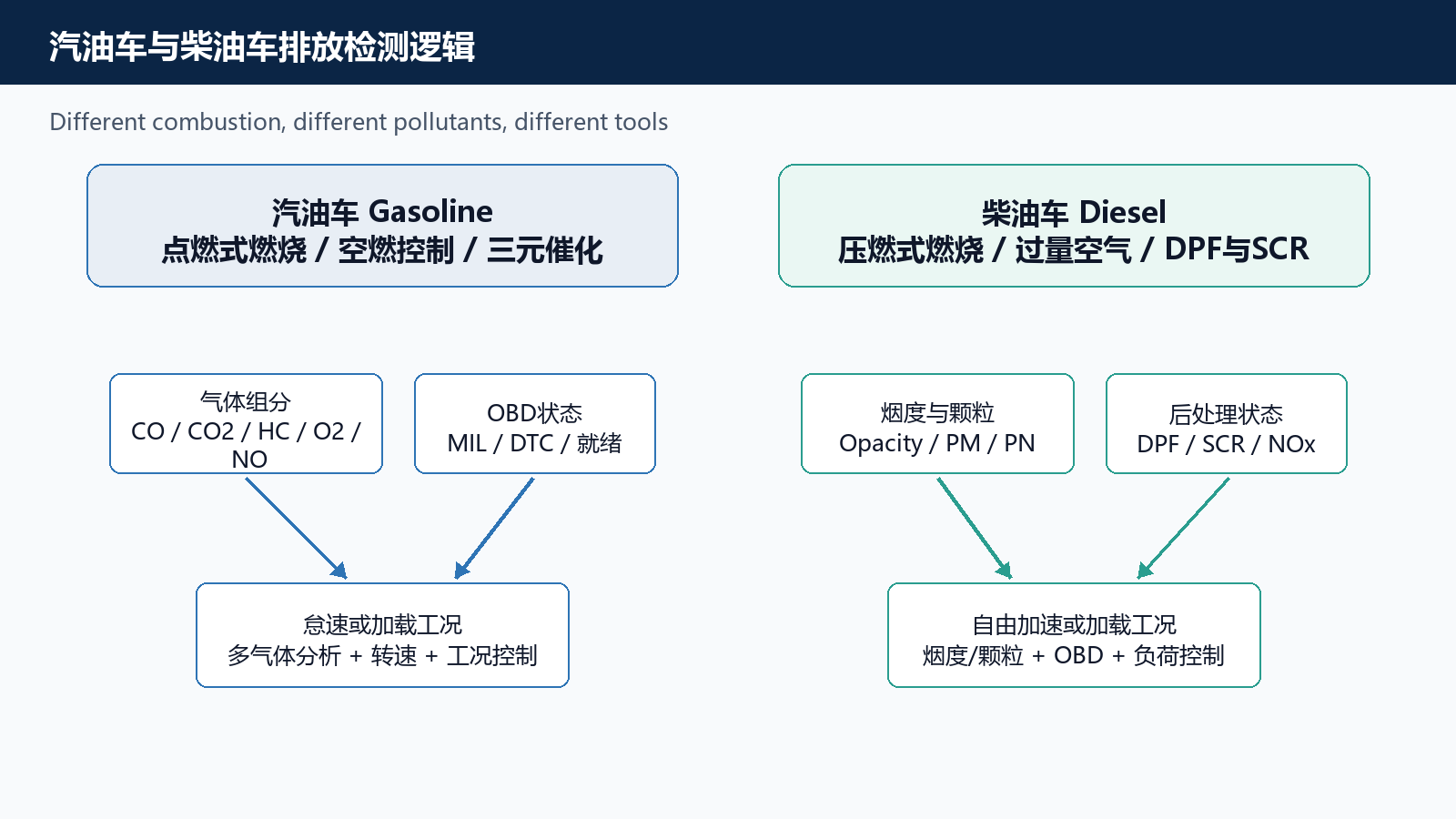
Both procedures are called emissions testing, but the shared name hides a fundamental difference. Gasoline inspection normally quantifies gaseous constituents; diesel smoke testing evaluates optical attenuation or opacity produced by particulate-rich exhaust.
The correct instrument therefore follows the prescribed method, vehicle technology and test condition. Visual similarity between two cabinets says nothing about whether the measurement is legally or technically equivalent.
Different measurands, different sensors
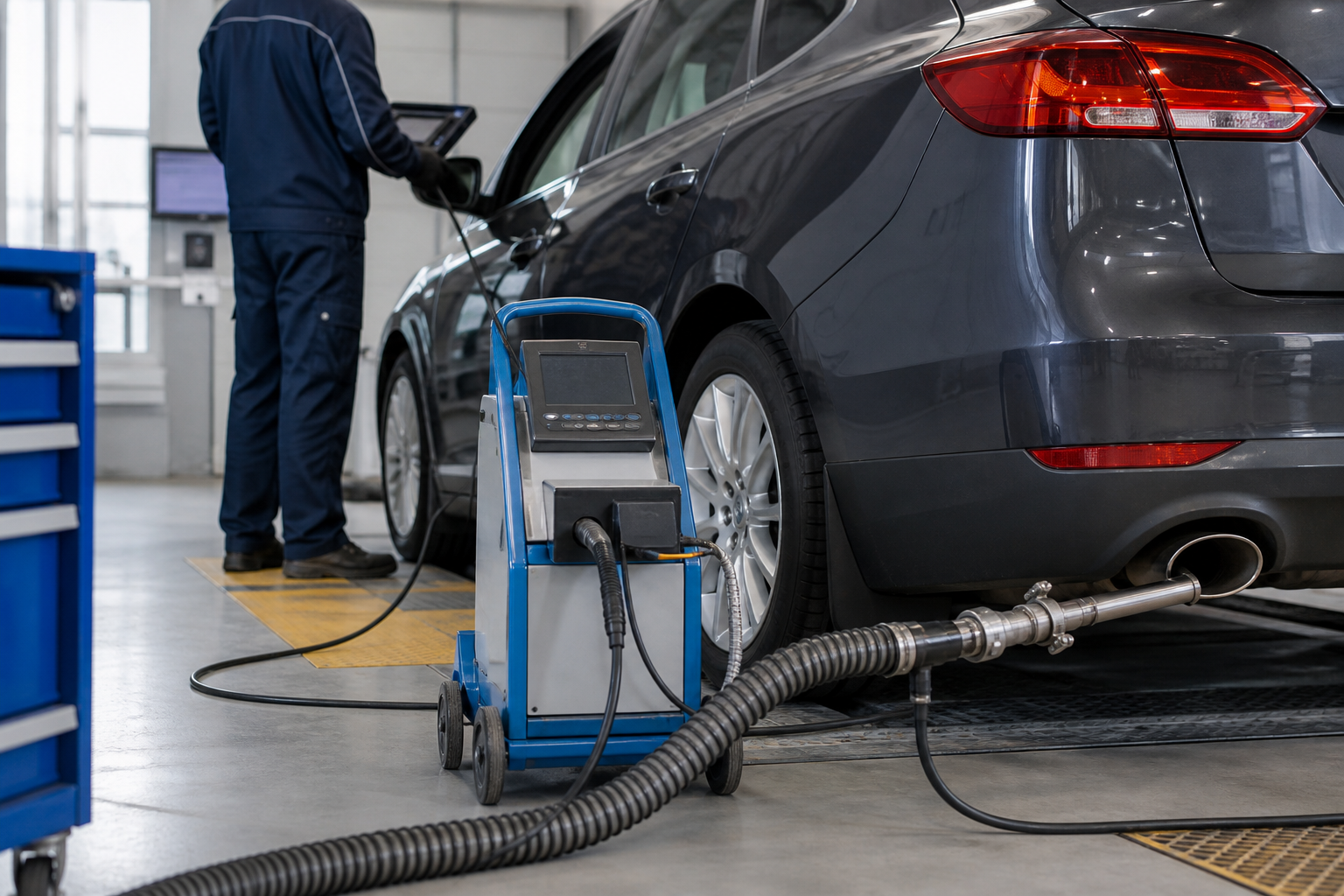
Gasoline analysis commonly measures CO, CO2, HC and O2, with NO or NOx included where required. Infrared and electrochemical channels have distinct response, interference and maintenance characteristics. Results may also be used to calculate lambda or dilution checks.
Diesel opacity measurement sends light through the exhaust plume and calculates attenuation over a defined optical path. Soot deposition, window cleanliness, purge air and exhaust-pulse capture directly influence the reading.
The procedure controls the equipment chain
Two-speed idle testing requires stable engine speed, correct warm-up and valid sampling. Loaded gasoline methods add dynamometer control and synchronized concentration data. Free-acceleration diesel testing requires valid acceleration detection and a controlled sequence of runs.
A diesel lugdown method adds vehicle loading, speed control, cooling and stronger safety provisions. It should not be described as a smoke meter with an optional roller set; the dynamometer is part of the measurement method.
Shared infrastructure does not make the methods identical
Gasoline and diesel lanes may share vehicle identification, environmental data, networking, video and reporting platforms. They may also share some workshop services and exhaust extraction design.
The analyzers, calibration media, sampling accessories, daily checks, acceptance logic and consumables remain method-specific. Shared software should preserve separate workflows and prevent the wrong method or limit set from being applied.
Vehicle technology changes preparation
Catalyst condition, closed-loop control, hybrid operating strategy and readiness status affect gasoline results. Diesel aftertreatment, turbocharger response, electronic speed limitation and diesel particulate filters affect smoke behavior.
The procedure should establish how to handle hybrids, vehicles that cannot hold a commanded speed, visible faults, unsafe tires, abnormal temperatures or regeneration events. The instrument cannot compensate for an invalid vehicle state.
Quality control must follow the measurand
Gas analyzers require leak checks, zero/span control and suitable reference gases. Opacimeters require optical checks, cleanliness control and verification of the light path and response. RPM and environmental channels need their own checks.
Records should show the condition of the complete system at the time of test. Passing a check on the main cabinet does not prove that a blocked hose, contaminated window or incorrect RPM source was acceptable.
Which modules can be shared and which must remain separate
Separate requirements by fuel, vehicle class and legally prescribed method. Then define which infrastructure can be shared and which components must remain independent.
Choose from the method outward: measurand, vehicle condition, sampling, supporting signals, lane equipment, software, metrology and service. Starting from the product name reverses the engineering logic.
Official references
This article is based on the official publications below. Verify the current edition, effective date and local authority requirements before application.
- GB 18285-2018: Limits and measurement methods for emissions from gasoline vehicles, including the two-speed idle and simplified driving-mode methods; effective 1 May 2019.
- GB 3847-2018: Limits and measurement methods for emissions from diesel vehicles, including free-acceleration and lugdown methods; effective 1 April 2019.
- QCVN 85:2025/BNNMT: Vietnam technical regulation for emissions from in-use motor vehicles, including five levels for CO, HC and diesel smoke opacity; effective 16 December 2025.
- US EPA I/M guidance: Vehicle emissions inspection and maintenance programs are implemented by state and local programs under the Clean Air Act; OBD is a major component.
- MEE: GB 18285—2018
- MEE: GB 3847—2018