Global Guide to Vehicle Inspection Equipment
A practical guide to measurement principles, equipment combinations and inspection frameworks in China, Vietnam, Thailand, the European Union, the United States and India.
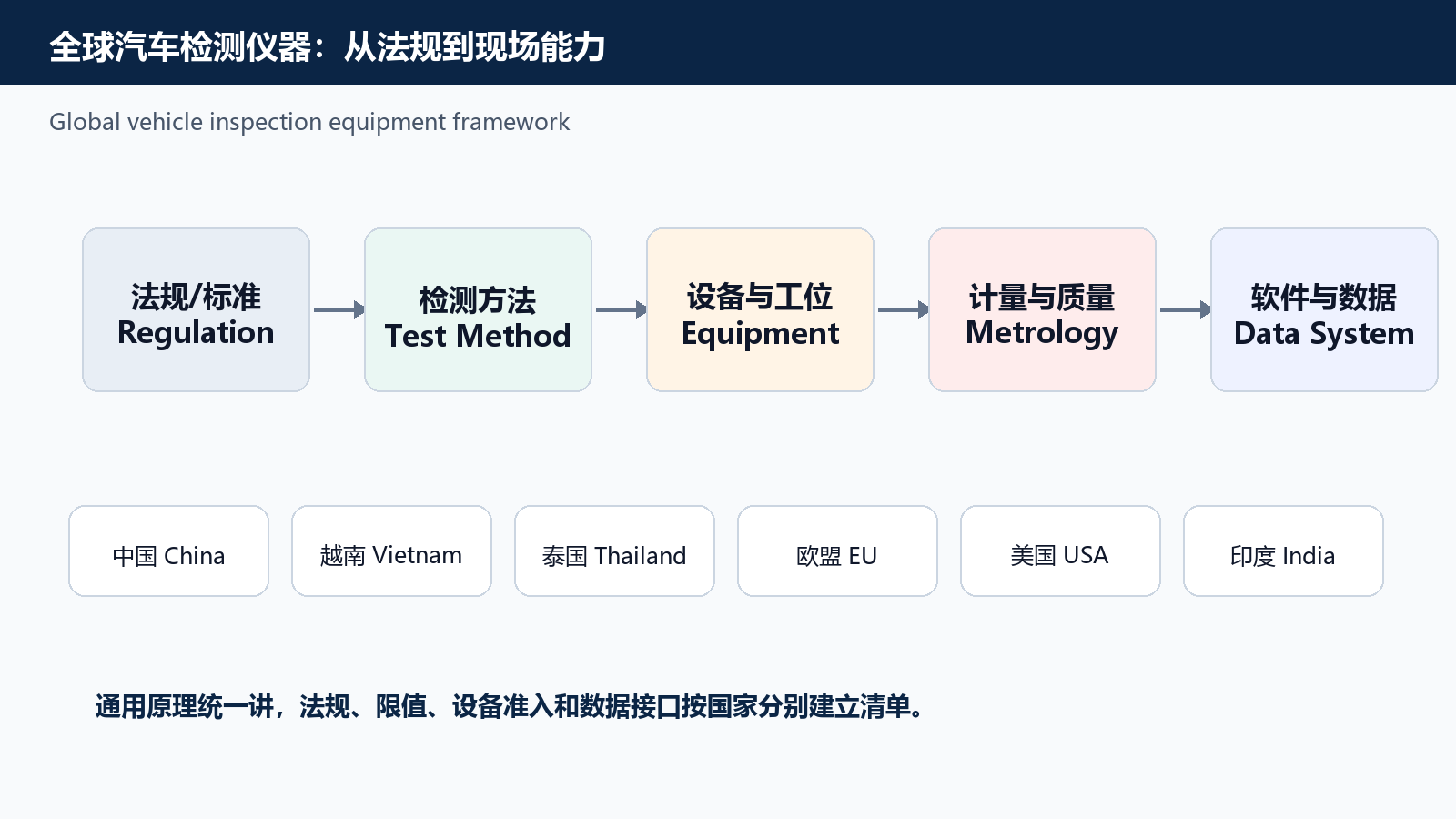
Vehicle inspection uses common measurement principles, but test items, limits, equipment approval, metrological control and data reporting are established by each jurisdiction. A technically capable instrument is therefore not automatically suitable for every market.
Use this guide in two stages: first identify what must be measured and under which operating condition; then verify the current legal text, local implementation rules and station-approval requirements for the destination country.
China
Roadworthiness inspection, gasoline emissions, diesel emissions and operational safety inspection for new-energy vehicles are organized under separate national standards. Core references include GB 38900-2020, GB 18285-2018, GB 3847-2018 and GB/T 44500-2024.
A station configuration normally separates safety, gasoline, diesel and NEV functions while coordinating networking, video records, metrology and institutional accreditation. The equipment list should be derived from the approved inspection scope, not the other way around.
Vietnam
Vietnam has recently updated vehicle inspection procedures, facility requirements and in-use emissions regulations. Circulars 46, 47 and 50 of 2024, QCVN 103:2024/BGTVT, QCVN 85:2025/BNNMT and Decision 43/2025/QD-TTg must be read together for current projects.
Configuration should distinguish vehicle classes, emissions levels and rollout dates. Gasoline CO/HC measurement and diesel free-acceleration smoke opacity require different instruments, while Vietnamese-language software and compatibility with the local data process are project-critical.
Thailand
Vehicle inspection is administered by the Department of Land Transport (DLT). Government facilities and licensed private inspection stations apply DLT rules according to vehicle class and use.
Braking, gasoline CO/HC, diesel smoke, headlamps and noise should be configured against the relevant DLT inspection and equipment notices. Limits or acceptance logic from another country should never be copied into a Thai project without local confirmation.
European Union
Directive 2014/45/EU provides a minimum framework for periodic roadworthiness testing, while Member States determine implementation details. Type approval under Regulation (EU) 2018/858 is a different legal function from periodic in-use inspection.
The target Member State must be identified before equipment is specified. Test frequency, approved equipment, data transmission, calibration arrangements and operating procedures remain subject to national implementation even where the technical principle is shared.
United States
Emissions inspection and maintenance programs operate under the Clean Air Act but are implemented by states and local areas. Safety inspection also varies by state. FMVSS governs new-vehicle safety and is not a nationwide periodic-inspection program.
A US proposal should identify the state, county or program area, model years, vehicle classes and OBD requirements. Whether tailpipe measurement remains necessary, how results are evaluated and where data are transmitted depends on the specific I/M program.
India
India is expanding automated fitness testing for commercial vehicles through Automated Testing Station rules. The program combines mechanical test equipment with recognition, surveillance, central data exchange and electronic reporting.
Station automation, IT integration, network compliance and authorization need to be designed as one system. The ability of a tester to exchange controlled data can be as important as its standalone measurement performance.
International references and selection discipline
UNECE WP.29 instruments support international harmonization and type approval, while ISO/IEC 17025 defines laboratory competence. Adoption into in-use inspection still depends on national law.
Procurement sequence: identify the jurisdiction and inspection scope; confirm the current method and limits; define the complete lane and data chain; verify metrology, installation, training and after-sales support; then approve the final equipment list.
Technical deep dives
Official references
This article is based on the official publications below. Verify the current edition, effective date and local authority requirements before application.
- GB 18285-2018: Limits and measurement methods for emissions from gasoline vehicles, including the two-speed idle and simplified driving-mode methods; effective 1 May 2019.
- GB 3847-2018: Limits and measurement methods for emissions from diesel vehicles, including free-acceleration and lugdown methods; effective 1 April 2019.
- GB 38900-2020: Items and methods for roadworthiness inspection of motor vehicles; effective 1 January 2021.
- GB/T 37536-2019: Intermediate-check specification for equipment used by motor-vehicle inspection bodies; confirmed current after review on 18 March 2026.
- GB/T 13564-2022: Roller brake testers for motor vehicles; effective 1 October 2022.
- GB/T 18276-2017: Chassis-dynamometer test methods and evaluation criteria for vehicle power performance; confirmed current after review on 8 December 2025.
- GB/T 44500-2024: Inspection code for the operational safety performance of new-energy vehicles; effective 1 March 2025.
- GB 18384-2025 and GB 38031-2025: Safety requirements for electric vehicles and traction batteries; effective 1 July 2026.
- Vietnam Circular 47/2024/TT-BGTVT: Inspection procedures for motor vehicles and special-purpose vehicles; effective 1 January 2025.
- Vietnam Circular 46/2024/TT-BGTVT: Certification procedures for vehicle inspection bodies and motorcycle-emissions inspection bodies; effective 1 January 2025.
- Vietnam Circular 50/2024/TT-BGTVT and QCVN 103:2024/BGTVT: Technical requirements for the facilities and location of vehicle inspection bodies; effective 1 January 2025.
- QCVN 85:2025/BNNMT: Vietnam technical regulation for emissions from in-use motor vehicles, including five levels for CO, HC and diesel smoke opacity; effective 16 December 2025.
- Vietnam Decision 43/2025/QD-TTg: Implementation roadmap for the in-use vehicle emissions regulation; effective 1 March 2026.
- Thailand DLT Vehicle Inspection Rules, Amendment No. 3 (B.E. 2566): Revised vehicle inspection and result-evaluation rules; effective 2 May 2023.
- Thailand DLT Roller Brake Tester Notice (B.E. 2555): Form, dimensions, standards and performance requirements for roller brake testers used by private inspection stations.
- Directive 2014/45/EU: EU minimum framework for periodic roadworthiness tests; consolidated text current to 20 May 2023.
- Regulation (EU) 2018/858: EU framework for motor-vehicle type approval and market surveillance.
- Regulation (EU) 2024/1257 (Euro 7): EU type-approval rules for emissions and battery durability; applies to new M1/N1 types from 29 November 2026.
- US EPA I/M guidance: Vehicle emissions inspection and maintenance programs are implemented by state and local programs under the Clean Air Act; OBD is a major component.
- US NHTSA FMVSS: Federal Motor Vehicle Safety Standards in 49 CFR Part 571 use a manufacturer self-certification system.
- India Automated Testing Stations: MoRTH rules for recognition, regulation and control, emphasizing automated inspection and central data transmission.
- UNECE WP.29 / UN Regulations: The 1958, 1997 and 1998 Agreements cover type approval, global technical regulations and periodic technical inspection.
- UN Regulations R13, R13-H, R48, R100, R154 and R168: International regulatory subjects including braking, lighting installation, electric powertrain safety, WLTP and global RDE.
- ISO/IEC 17025:2017: International requirements for the competence, impartiality and consistent operation of testing and calibration laboratories; confirmed current in 2023.
- ISO 10521-2 and ISO 1585: International standards related to chassis-dynamometer road-load simulation and engine net-power testing.
- MEE: GB 18285—2018
- MEE: GB 3847—2018
- SAMR: GB 38900—2020
- SAMR: On-site assessment guidance for vehicle inspection bodies
- SAMR: Supplementary technical requirements