OBD and Tailpipe Emissions Measurement: Evidence Boundaries of Diagnostic Data and Measured Results
OBD reveals monitored faults and readiness inside the vehicle, while tailpipe instruments measure the exhaust leaving it. A robust inspection program understands both and applies each within its legal scope.
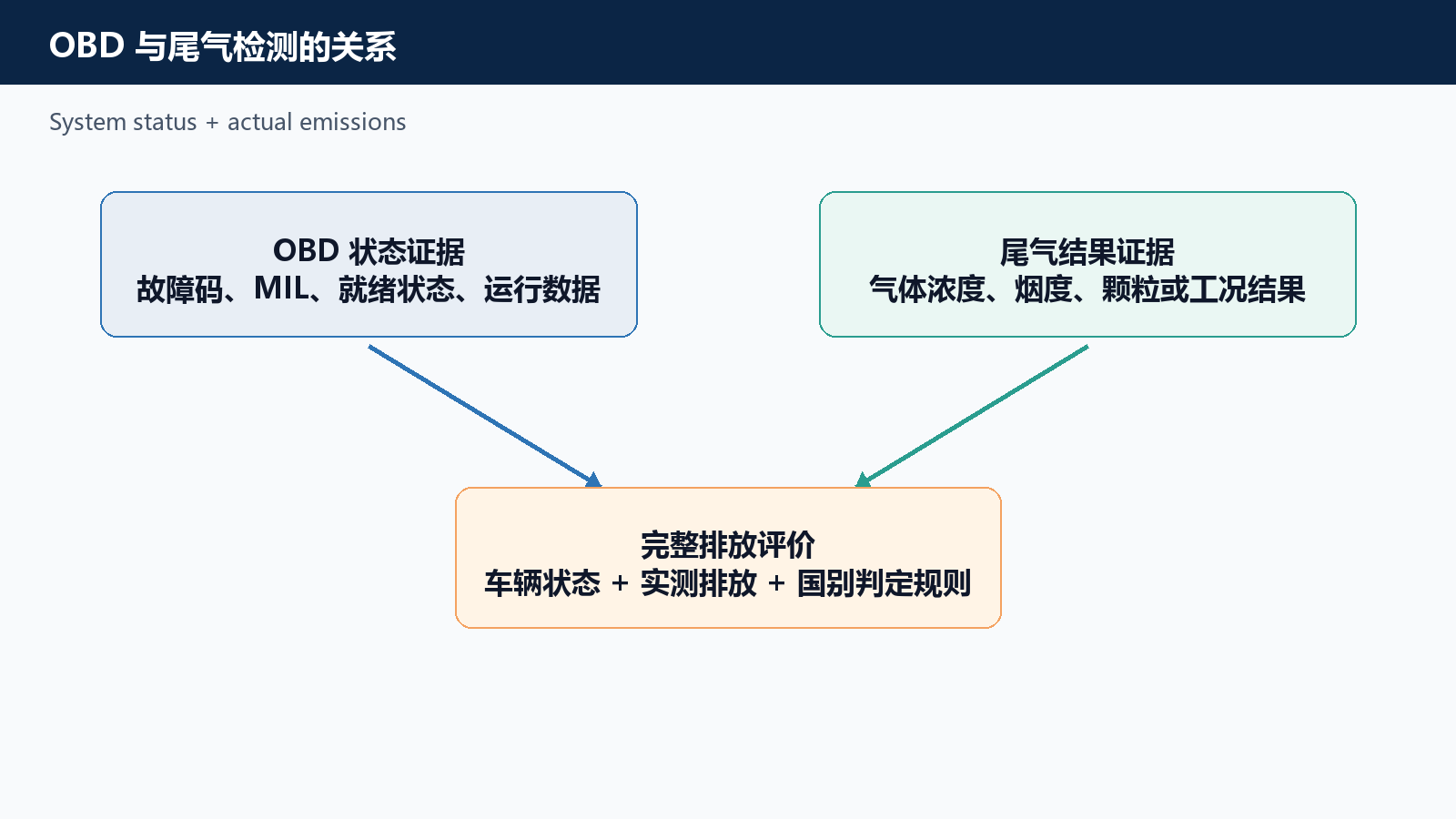
On-board diagnostics gives the inspector access to the vehicle's own monitoring results. It can identify diagnostic trouble codes, malfunction-indicator status, readiness monitors and selected operating parameters.
That information is valuable, but it is not the same quantity as CO, HC, NOx or smoke opacity measured externally. The two approaches answer related but different questions and should not be substituted without an explicit regulatory basis.
What OBD can establish
OBD can show whether the vehicle has detected a monitored malfunction, whether the malfunction indicator lamp has been commanded on and whether relevant monitors have completed. It can also expose communication faults or suspiciously reset readiness status.
The available information depends on model year, protocol, powertrain and local regulation. A diagnostic tool may be capable of reading manufacturer-specific data that a statutory inspection is not authorized or required to use.
What OBD cannot establish by itself
A vehicle may have no stored emissions DTC and still produce excessive tailpipe emissions because of deterioration, fuel, tampering or a condition outside the monitored threshold. Conversely, a stored code does not quantify the concentration emitted during the inspection.
OBD also cannot replace diesel opacity measurement where smoke is the regulated quantity, nor can it reproduce loaded exhaust behavior unless the program explicitly defines an OBD-only alternative.
Readiness is not a simple pass symbol
Readiness monitors indicate whether defined diagnostic routines have run since codes were cleared or power was interrupted. 'Not ready' can reflect recent repair, battery disconnection, insufficient driving or deliberate reset.
The allowed number of incomplete monitors varies by jurisdiction, model year and vehicle type. Software must apply the local decision table and retain the raw monitor states rather than reducing them to an undocumented green or red icon.
Communication integrity matters
The inspection device should identify protocol, VIN where available, ECU identity, connection status, DTCs, lamp command and readiness data with controlled timestamps. Failed or unstable communication must be recorded distinctly from a vehicle with no faults.
Cable quality, connector condition, vehicle voltage, software database and anti-tampering controls affect reliability. Automatic vehicle identification should be cross-checked against registration data to prevent record mismatch.
Combining OBD and physical measurement
A mature workflow compares OBD evidence, vehicle condition and the applicable physical test. Conflicting results should trigger the defined review or retest process, not an improvised override.
In gasoline programs, OBD may precede or accompany gas analysis. In diesel programs, it can help identify engine and aftertreatment status while the opacimeter measures smoke. The exact sequence is jurisdiction-specific.
Equipment and report requirements
Specify protocol coverage, vehicle database updates, data fields, authority interface, user permissions, cybersecurity, audit trail and technical support. Reports should preserve individual monitor states and DTC identities when legally permitted.
OBD is a diagnostic witness inside the vehicle; the tailpipe instrument is an independent measurement outside it. Their evidence is strongest when the program defines how to use both.
Official references
This article is based on the official publications below. Verify the current edition, effective date and local authority requirements before application.
- GB 18285-2018: Limits and measurement methods for emissions from gasoline vehicles, including the two-speed idle and simplified driving-mode methods; effective 1 May 2019.
- GB 3847-2018: Limits and measurement methods for emissions from diesel vehicles, including free-acceleration and lugdown methods; effective 1 April 2019.
- QCVN 85:2025/BNNMT: Vietnam technical regulation for emissions from in-use motor vehicles, including five levels for CO, HC and diesel smoke opacity; effective 16 December 2025.
- Directive 2014/45/EU: EU minimum framework for periodic roadworthiness tests; consolidated text current to 20 May 2023.
- US EPA I/M guidance: Vehicle emissions inspection and maintenance programs are implemented by state and local programs under the Clean Air Act; OBD is a major component.
- MEE: GB 18285—2018
- MEE: GB 3847—2018
- SAMR: On-site assessment guidance for vehicle inspection bodies