
Seven Conditions to Confirm Before Building a Vehicle Inspection Station
Before finalizing equipment, confirm the legal scope, vehicle population, site, utilities, data connection, metrology, staffing and lifecycle support that determine whether the station can be approved and operated.
Most costly station changes do not begin with a defective tester. They begin with an assumption that was never confirmed: the wrong vehicle class, insufficient lane length, an unavailable data interface or a local approval condition discovered after construction.
A disciplined pre-check turns those assumptions into written inputs before civil work and procurement are locked.
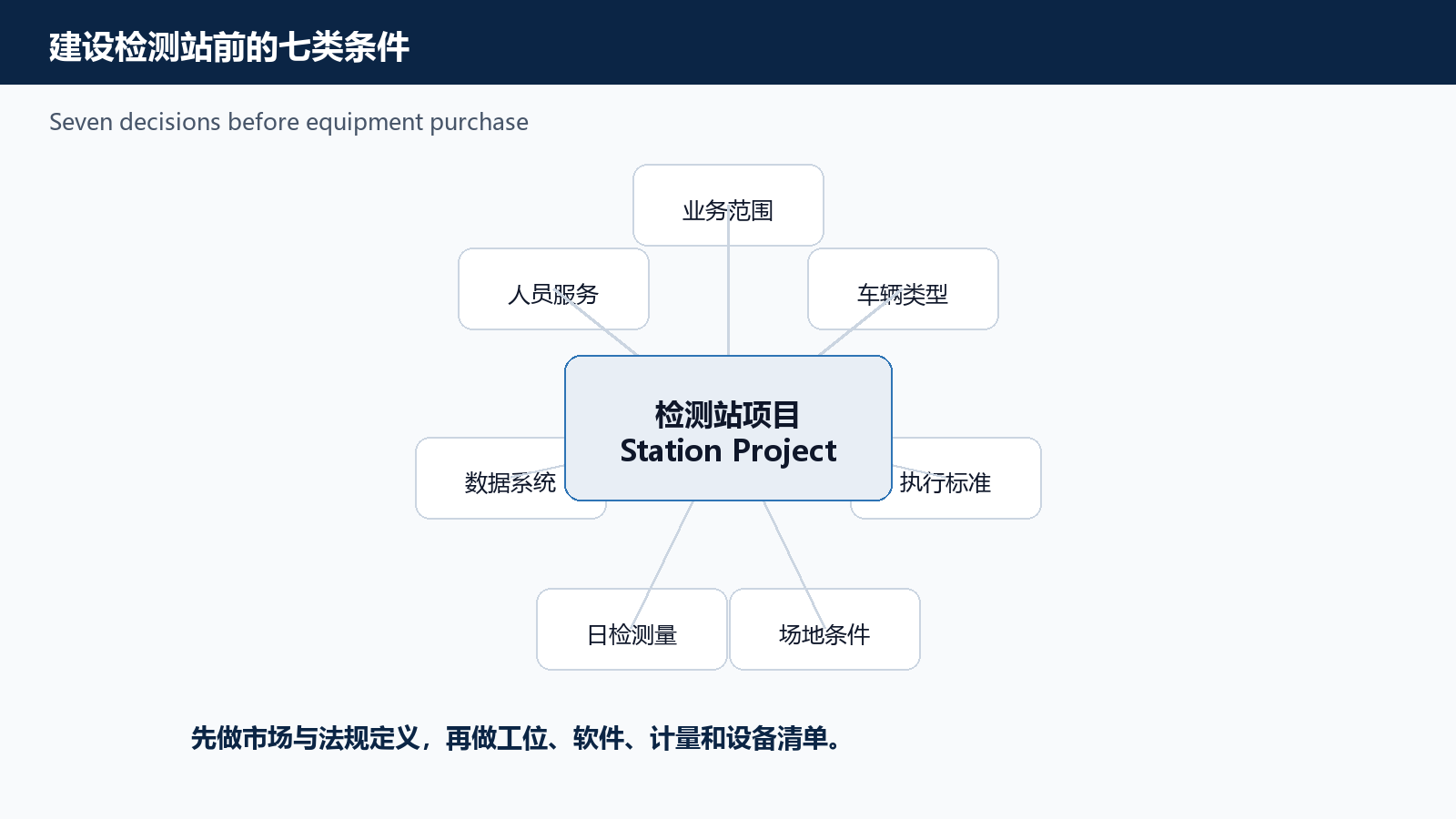
1. Legal and accreditation scope
Identify the authority, inspection categories, applicable legislation, accreditation route and equipment-approval process. Record the exact editions and implementation dates, including transitional provisions.
Clarify whether safety and emissions activities require separate licenses, staff, data channels or facility areas. A national standard may not contain every provincial or program requirement.
2. Vehicle population and capacity
Define passenger cars, motorcycles, buses, light and heavy commercial vehicles, axle configurations, maximum axle load, wheelbase, track width, tire size, ground clearance and expected fuel or powertrain mix.
Use real arrival patterns to set hourly and daily capacity. Include seasonal peaks, retests, failed communication and time required for heavy or unusual vehicles.
3. Site geometry and civil works
Confirm plot access, traffic direction, queue storage, turning radius, headroom, lane level, drainage, pits, foundations, emergency exits and safe pedestrian separation. Survey levels before ordering equipment that depends on alignment.
Allow removal routes for disabled or unsafe vehicles and maintenance access around rollers, lifts, fans and cabinets. Future expansion space is cheaper before the building is complete.
4. Utilities and environmental control
Document voltage, frequency, earthing, power quality, backup power, compressed air, network, lighting, ventilation, exhaust extraction, cooling airflow, temperature, humidity and water management.
Loaded emissions and performance testing can generate heat and exhaust rapidly. Utility capacity should be calculated for simultaneous operation, not from nominal consumption of one device.
5. Data and supervisory interfaces
Obtain the authority's interface specification, test environment, security requirements and acceptance process. Define vehicle identity, equipment status, raw data, images, video, reports, signatures, offline handling and retention.
Set responsibility for network hardware, certificates, firewalls, updates and incident support. A vendor's generic API description is not evidence of connection to the local platform.
6. Metrology, personnel and procedures
List instruments requiring calibration or legal verification, available local service providers, intermediate-check references and required uncertainty or class. Confirm delivery times for reference gases and consumables.
Prepare staffing by role, authorization, shift and language. Training should cover measurement, vehicle safety, invalid tests, equipment faults, data review and emergency procedures.
7. Delivery and after-sales support
Define factory acceptance, site acceptance, installation, commissioning, training, documentation, warranty scope, spare-parts stock, remote access and response times. Include software and vehicle-database updates.
Do not release the final purchase order until every critical assumption has an owner, a source document and an acceptance method. Unresolved items should remain visible, not hidden in general wording.
Official references
This article is based on the official publications below. Verify the current edition, effective date and local authority requirements before application.
- GB 38900-2020: Items and methods for roadworthiness inspection of motor vehicles; effective 1 January 2021.
- Vietnam Circular 47/2024/TT-BGTVT: Inspection procedures for motor vehicles and special-purpose vehicles; effective 1 January 2025.
- Vietnam Circular 46/2024/TT-BGTVT: Certification procedures for vehicle inspection bodies and motorcycle-emissions inspection bodies; effective 1 January 2025.
- Vietnam Circular 50/2024/TT-BGTVT and QCVN 103:2024/BGTVT: Technical requirements for the facilities and location of vehicle inspection bodies; effective 1 January 2025.
- Thailand DLT Vehicle Inspection Rules, Amendment No. 3 (B.E. 2566): Revised vehicle inspection and result-evaluation rules; effective 2 May 2023.
- Directive 2014/45/EU: EU minimum framework for periodic roadworthiness tests; consolidated text current to 20 May 2023.
- US EPA I/M guidance: Vehicle emissions inspection and maintenance programs are implemented by state and local programs under the Clean Air Act; OBD is a major component.
- India Automated Testing Stations: MoRTH rules for recognition, regulation and control, emphasizing automated inspection and central data transmission.
- SAMR: GB 38900—2020
- SAMR: On-site assessment guidance for vehicle inspection bodies
- SAMR: Supplementary technical requirements