
Vehicle Inspection Station Configuration: From Devices to System Capability
Plan the station around the approved inspection scope, vehicle flow, measurement traceability, software, video records, personnel and long-term service.
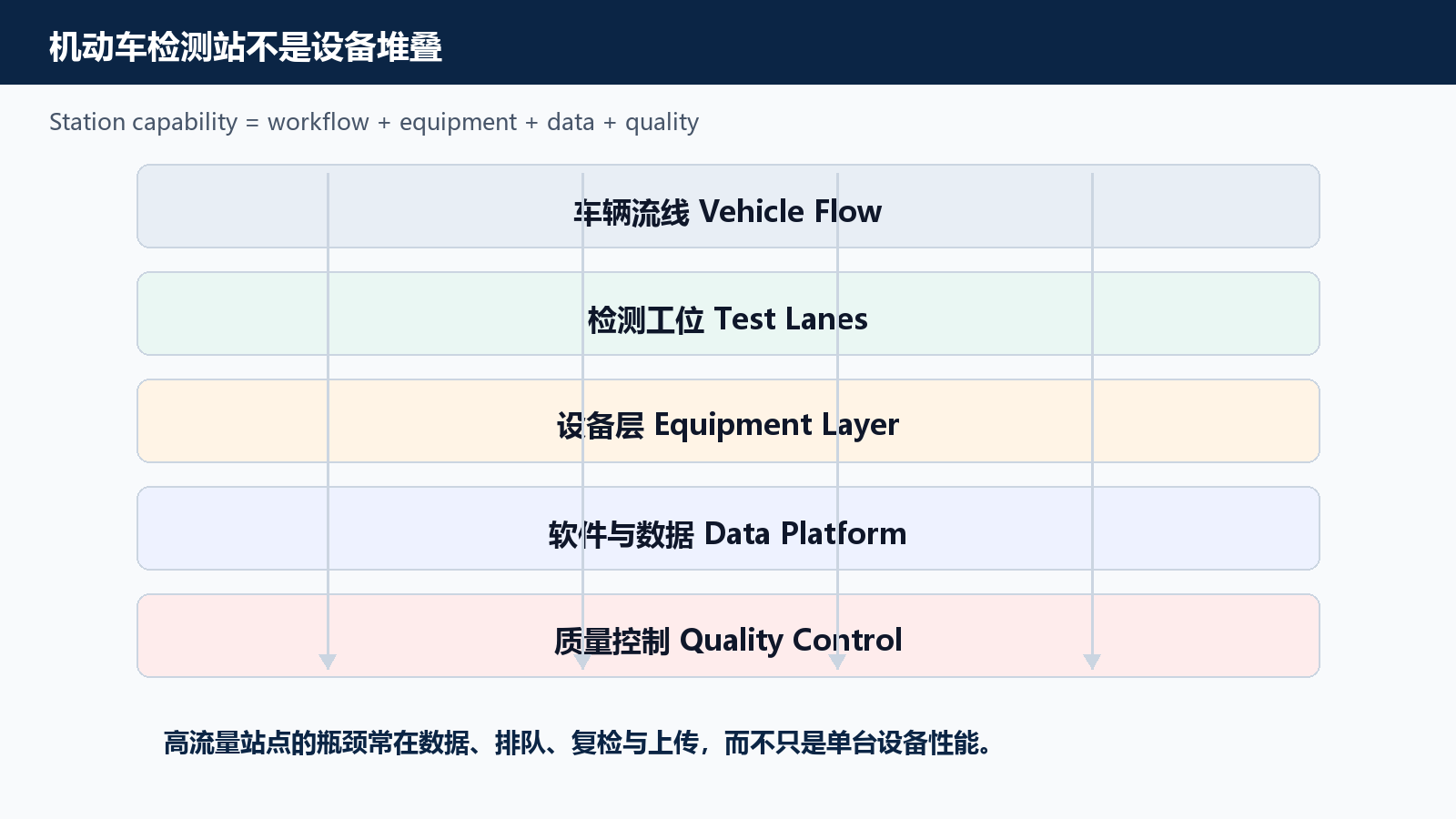
An inspection station is not a warehouse of independent testers. It is an operational system in which vehicle movement, measurement, identity, equipment status, result review and regulatory reporting must remain synchronized.
The design should begin with the intended license or accreditation scope: vehicle classes, safety and emissions items, daily throughput, retest policy and the authority that receives the data.
Define the inspection scope before the equipment list
List each vehicle category and each required test, including visual inspection, brakes, sideslip, suspension where applicable, speedometer, headlamps, noise, gasoline emissions, diesel smoke and OBD. Mark tests that depend on local alternatives or vehicle configuration.
This matrix prevents two common errors: buying equipment outside the approved scope and discovering too late that a required vehicle class exceeds the tester's axle load, track width, wheelbase or operating range.
Design vehicle flow and retest flow together
Entry identification, waiting areas, lane sequence, safe spacing, abnormal-vehicle removal and retest routes should be drawn at full vehicle scale. Heavy vehicles require turning radii, headroom, pit or lift access and ventilation that passenger-car layouts may not provide.
Throughput should be calculated from the slowest controlled step, not from the fastest instrument. Include positioning, stabilization, operator actions, data review, rejected runs and periodic quality checks.
Connect data without weakening traceability
Vehicle identity, operator identity, equipment serial number, software version, original readings, images or video and the final decision should be linked by a controlled record. Manual transcription should be minimized and every correction should be attributable.
Interfaces must define data fields, units, timestamps, retry behavior, offline operation, authority acknowledgements and cybersecurity responsibilities. A demo connection is not the same as an accepted production interface.
Accept equipment, software and metrology together
Commissioning should verify repeatability, zero or reference checks, alarm behavior, interlocks, data exchange, video association, backup and recovery. The lane is not accepted merely because every device can be powered on.
Calibration certificates, metrological verification, intermediate-check tools and maintenance records must match the actual instruments and ranges. Reference equipment also requires control, storage and traceability.
People and operating procedures
Operators need task-specific training; technical managers and authorized signatories need the competence required by the local accreditation system. Access rights should reflect these roles rather than sharing one administrator account.
Written procedures should cover vehicle preparation, invalid tests, equipment failure, retest, data correction, environmental limits, daily opening checks and emergency response. Training should use the delivered software and representative vehicles.
Lifecycle service and expansion
Budget for foundations, power quality, compressed air where needed, ventilation, network, video, reference materials, consumables, spares and preventive maintenance. Confirm response times and diagnostic access before commissioning.
A station is ready when it can produce repeatable, traceable and reviewable results under the approved workflow, including faults and retests, not when the last machine arrives.
Official references
This article is based on the official publications below. Verify the current edition, effective date and local authority requirements before application.
- GB 38900-2020: Items and methods for roadworthiness inspection of motor vehicles; effective 1 January 2021.
- Vietnam Circular 47/2024/TT-BGTVT: Inspection procedures for motor vehicles and special-purpose vehicles; effective 1 January 2025.
- Vietnam Circular 46/2024/TT-BGTVT: Certification procedures for vehicle inspection bodies and motorcycle-emissions inspection bodies; effective 1 January 2025.
- Vietnam Circular 50/2024/TT-BGTVT and QCVN 103:2024/BGTVT: Technical requirements for the facilities and location of vehicle inspection bodies; effective 1 January 2025.
- Thailand DLT Vehicle Inspection Rules, Amendment No. 3 (B.E. 2566): Revised vehicle inspection and result-evaluation rules; effective 2 May 2023.
- Directive 2014/45/EU: EU minimum framework for periodic roadworthiness tests; consolidated text current to 20 May 2023.
- India Automated Testing Stations: MoRTH rules for recognition, regulation and control, emphasizing automated inspection and central data transmission.
- ISO/IEC 17025:2017: International requirements for the competence, impartiality and consistent operation of testing and calibration laboratories; confirmed current in 2023.
- SAMR: GB 38900—2020
- SAMR: On-site assessment guidance for vehicle inspection bodies
- SAMR: Supplementary technical requirements